
How Fennimore Health put 31 clinics on one rota app
31
clinics planning rotas in one app
94%
of open shifts filled within 48 hours
5 hrs
of planning saved per manager each week
At a glance
Industry
Healthcare
Company size
3,100 people
Headquarters
Denver, CO
Team
Operations
Builders and members
6 builders, 280 members
Apps built
12 apps
Built with


The company
Fennimore Health runs 31 outpatient clinics across Colorado and Wyoming, from urgent care to physical therapy. Its 3,100 clinicians and staff handle about 900,000 patient visits a year.
31 clinics, 31 spreadsheets
Each Fennimore clinic planned its staff rota in its own spreadsheet. Managers copied last week’s file, filled the gaps by phone and emailed the result to payroll, where two people spent two days of every pay period reconciling hours from 31 formats. Nobody could see coverage across a region, and a nurse who picked up shifts at two clinics appeared in two files that disagreed.
The files also held more than they should. Some rotas included appointment counts copied from the scheduling system, which meant patient-related data sat in email attachments.
Built by the people who use it
Priya Raman’s data team connected Chamfer to the scheduling data in BigQuery and set up Stockroom, Chamfer’s managed Postgres, to hold rota data. They imported the 31 spreadsheets in an afternoon. Then they asked two clinic managers to describe the tool they wished they had.
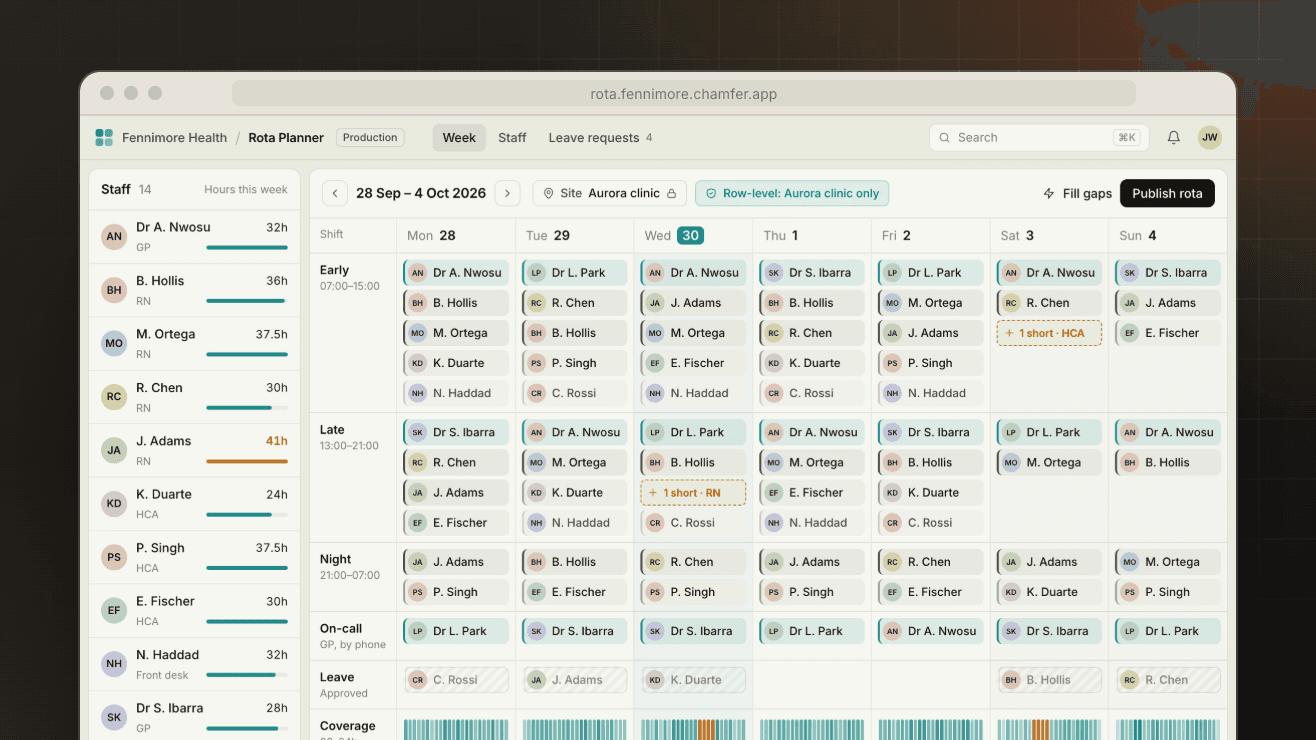
The first Rota Planner came from a single prompt: a week grid of shifts by role, staff chips you can move between days, and a coverage row that turns red when a shift is short. None of the clinic managers had built software before. They described their week in plain words, reviewed each draft on staging and asked for changes the same way, refining it over two weeks. Open shifts now go out as text messages through Twilio, and the first qualified person to reply yes gets the shift.
Access by site, written once
The data team’s condition was simple: a manager should never see staff or appointment numbers from another clinic. They wrote that rule as a Spec in one sentence, and Chamfer applies it at row level to every app that touches rota data. Regional directors see their region. Payroll sees hours but not appointments.
The compliance team reviewed the rule and the first three apps before launch, and approved each release. Access comes from Okta, so when a manager moves to a new clinic, their view moves with them. Every change to a rota is in the Logbook with a name and a timestamp.
“We wrote the privacy rule once, and every app since has followed it,” Priya says. “Nobody has to remember it.”
What changed
31 clinics planning rotas in one app, with access by site
94% of open shifts filled within 48 hours
About 5 hours of planning saved per manager each week
Since the Rota Planner, clinic managers have built 11 more apps, from supply orders to a regional coverage dashboard that directors check every Monday. Priya’s team now reviews each new app’s permissions in a weekly 30-minute session instead of building the apps themselves.
“Clinic managers build their own rota tools on Stockroom, and the row-level rules mean nobody sees a patient outside their site.”

Priya Raman
Director of Data, Fennimore Health
Read another story

How Kettleby Freight retired 14 spreadsheets in a quarter

Kettleby's finance operations team replaced 14 spreadsheet processes with Chamfer apps, each with a named approver before launch.
Read the story →

Halden Mutual cut claims triage from 3 days to 4 hours

Halden's claims team scores and routes every new claim within hours, and IT Risk answers its auditors straight from the Logbook.
Read the story →

Tessaly put 40 agents on a new refund queue in 4 days

Tessaly's support team described a refund queue on Monday and had 40 agents working it behind SSO by Thursday.
Read the story →