
Brennock Precision cut scrap 22% by taking QC off paper
22%
lower scrap rate in the first year
40 min
of paperwork saved per batch
1 day
to build the first QC app
At a glance
Industry
Energy & industrial
Company size
420 people
Headquarters
Sheffield, UK
Team
Operations
Builders and members
2 builders, 60 members
Apps built
5 apps
Built with


The company
Brennock Precision machines titanium and stainless steel parts for aerospace and medical device makers. Its 420 people run 60 CNC machines from a single plant in Sheffield, England.
Measurements on paper
Brennock machines parts to within 5 microns, and every batch is measured at the machine. Until 2025, every measurement went on a paper form. Inspectors wrote down the reading, compared it with the drawing and initialed the sheet. Scrap ran at 3.2% of machined parts, and most of it was caught only at final inspection. Customer audits meant days in the archive pulling paper records for a single batch.
A quality engineer typed the forms into a spreadsheet on Fridays. By then, a cutting tool that had started to drift on Tuesday could have produced three days of scrap.
One prompt, one day
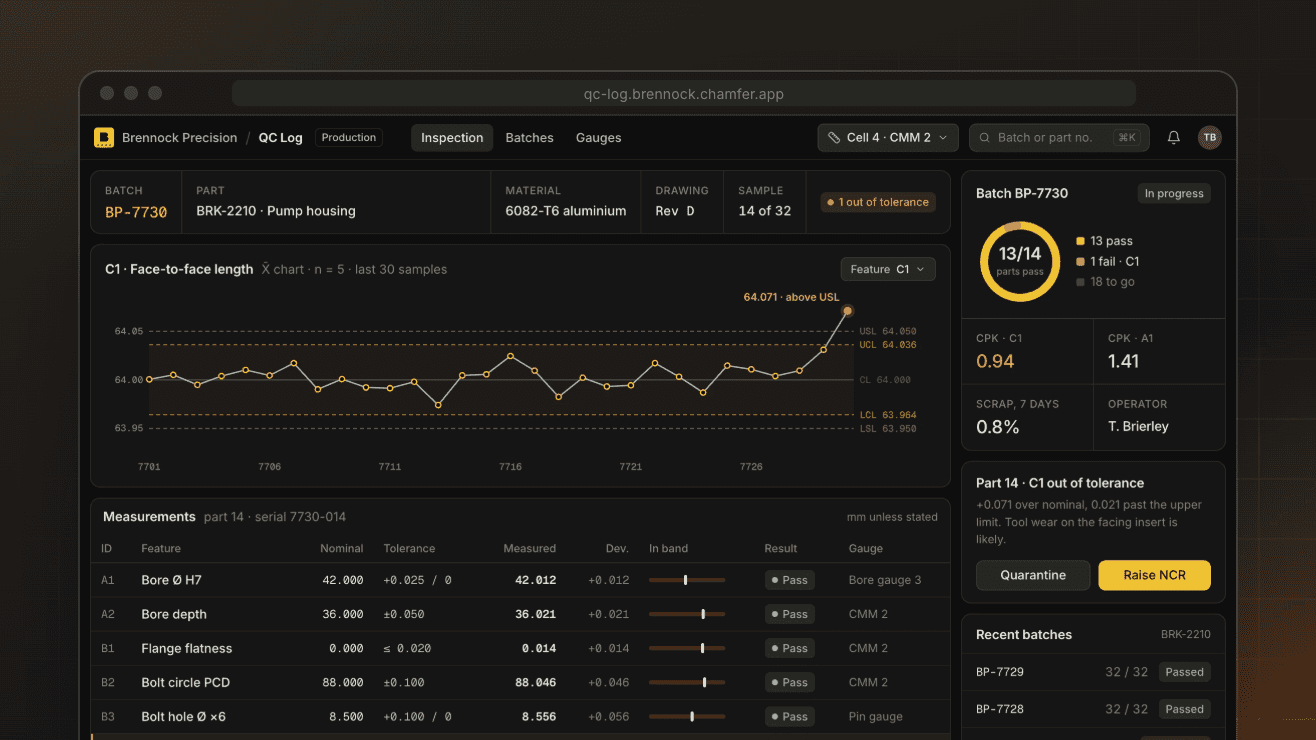
Rhys Pendleton, Quality Manager, described what he wanted on the Bench: a log for each batch with the nominal size, the allowed deviation and the measured value, a pass or fail tag for every part, and a control chart that shows drift before a part fails.
Gauge results already flowed into BigQuery from the coordinate measuring machines, so the first QC Log was reading live data before the shift ended. The first draft took 20 minutes. Rhys spent the rest of the day with two inspectors, adjusting the layout for gloved hands and adding the gauge ID to every reading. Inspectors use it on a tablet mounted at each cell. When three readings in a row move toward a limit, the app posts an alert to the cell’s Slack channel and asks the setter to check the tool.
Signed records for every batch
Aerospace customers ask for a full inspection record with every shipment. The QC Log produces it from the Logbook: who measured each part, when, on which gauge, and who approved the batch. A batch can be released only after a quality engineer approves it in the app, and that step can’t be skipped or delegated.
Inspectors can record measurements but can’t change them afterward. A correction needs a second person, and both values stay on the record. The Logbook also shows every change to the app itself, which matters to customers who audit how a supplier controls its quality system.
“The customer audit used to mean a week in the archive,” Rhys says. “Now I send a link.”
IT approved the rollout after a single review of the roles, and every cell had a tablet within the month.
What changed
Scrap rate down 22% in the first year
40 minutes of paperwork saved per batch
Inspection records sent with every shipment, generated from the Logbook
Brennock’s two builders have since added a gauge calibration tracker and a customer returns queue, and the maintenance team is building a spindle-hours log next.
“Our inspectors see a dimension drifting before it goes out of limits. We stop the machine on the reading, not on the customer's complaint.”
Rhys Pendleton
Quality Manager, Brennock Precision
Read another story

How Kettleby Freight retired 14 spreadsheets in a quarter

Kettleby's finance operations team replaced 14 spreadsheet processes with Chamfer apps, each with a named approver before launch.
Read the story →

Halden Mutual cut claims triage from 3 days to 4 hours

Halden's claims team scores and routes every new claim within hours, and IT Risk answers its auditors straight from the Logbook.
Read the story →

Tessaly put 40 agents on a new refund queue in 4 days

Tessaly's support team described a refund queue on Monday and had 40 agents working it behind SSO by Thursday.
Read the story →