
Brackwater moved turbine inspections off paper in 9 days
9 days
from first prompt to full rollout
60
technicians on one inspection app
2 hrs
from fault to work order, down from 2 days
At a glance
Industry
Energy & industrial
Company size
1,300 people
Headquarters
Aberdeen, UK
Team
Operations
Builders and members
3 builders, 75 members
Apps built
6 apps
Built with


The company
Brackwater Energy owns and runs 14 onshore wind farms and 6 solar sites across Scotland and northern England. Its 1,300 people look after 410 turbines, most of them hours from the nearest office.
A clipboard on every climb
Brackwater’s technicians inspect every turbine twice a year, climbing 80 meters with a paper checklist. The sheets went back to the site office on Fridays, where a coordinator typed the faults into a spreadsheet. Coordinators spent a day and a half each week retyping, and photos of damage lived on technicians’ own phones. A cracked blade found on a Monday could wait until the following Tuesday for a work order.
The company had tried a commercial inspection app, but it needed a public cloud connection, and several sites have none. Brackwater’s security policy also keeps operational data inside its own network.
Onsite, and on a phone
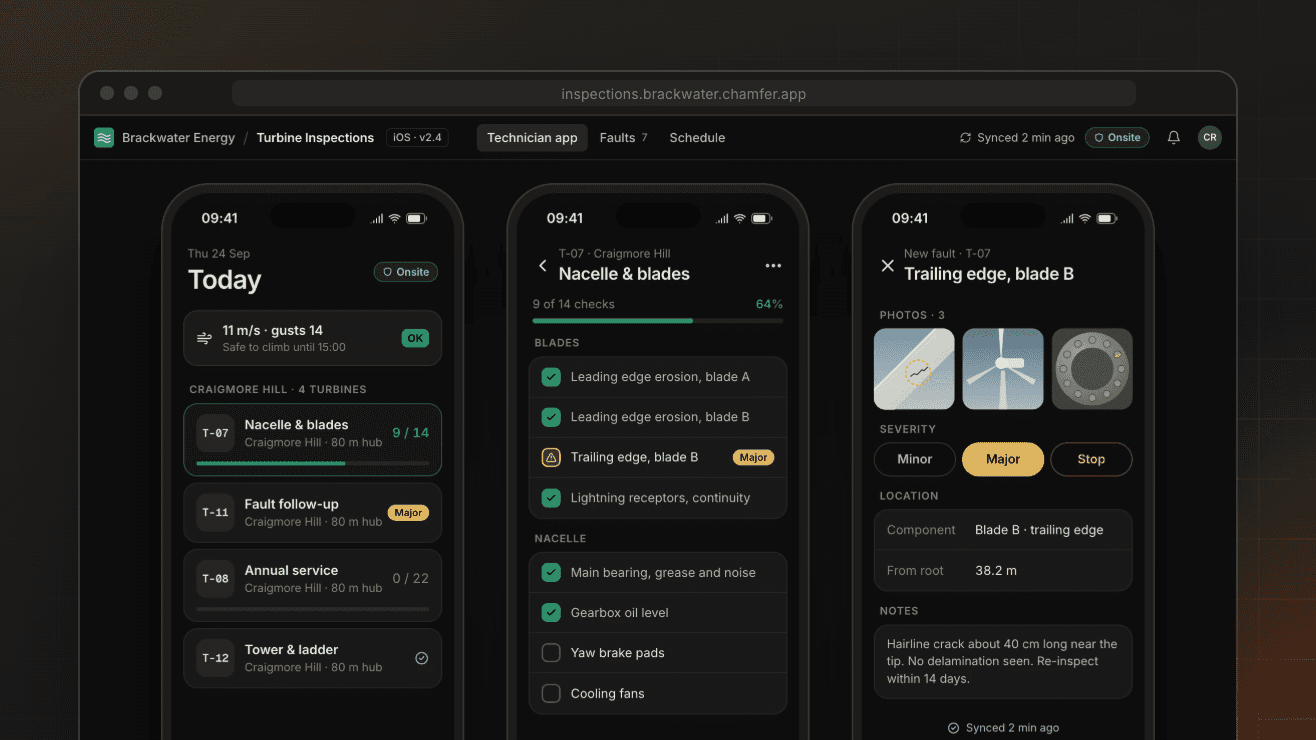
Brackwater runs Chamfer Onsite in its own data center, so the app builder, the apps and the Logbook all stay inside the network. Callum Reid’s team described the app in one prompt: a phone checklist for each turbine model, three photos per fault, a severity of Minor, Major or Stop, and a work order raised for anything above Minor.
Two technicians tested the first build on a Tuesday. They asked for bigger buttons, offline saving and a dark theme for night work. Offline saving mattered most: a technician can finish a full inspection with no signal, and the app syncs when the van reaches the site office. Brackwater’s IT team approved the first release that Friday, after checking the roles and the Onsite network rules. Seven days later, all 60 technicians had it on their phones.
Photos go to an S3-compatible store on site. Postgres holds the inspection records, a Databricks model reads them to predict gearbox wear, and any Stop fault posts to the control room’s Slack channel within a minute of being saved.
The right people see the right sites
Technicians see only the turbines at their assigned sites. Supervisors approve every Stop fault before a turbine returns to service, and the Logbook keeps the name, time and photos behind each decision. Each work order carries the inspection record, so the repair crew sees the photos before they climb. When a contractor finishes a job, their access ends with their account in Brackwater’s identity provider.
“The first version was on two phones before lunch,” Callum says. “The technicians shaped the rest, which is why they actually use it.”
What changed
60 technicians on one inspection app, 9 days after the first prompt
Fault to work order in 2 hours, down from 2 days
No paper checklists left at any of the 20 sites
Brackwater’s three builders have since added a spare-parts request app and a permit-to-work tracker, both running on the same Onsite install.
“Our inspection app went from prompt to 60 technicians in nine days, and it runs Onsite inside our own network.”

Callum Reid
Head of Field Operations, Brackwater Energy
Read another story

How Kettleby Freight retired 14 spreadsheets in a quarter

Kettleby's finance operations team replaced 14 spreadsheet processes with Chamfer apps, each with a named approver before launch.
Read the story →

Halden Mutual cut claims triage from 3 days to 4 hours

Halden's claims team scores and routes every new claim within hours, and IT Risk answers its auditors straight from the Logbook.
Read the story →

Tessaly put 40 agents on a new refund queue in 4 days

Tessaly's support team described a refund queue on Monday and had 40 agents working it behind SSO by Thursday.
Read the story →